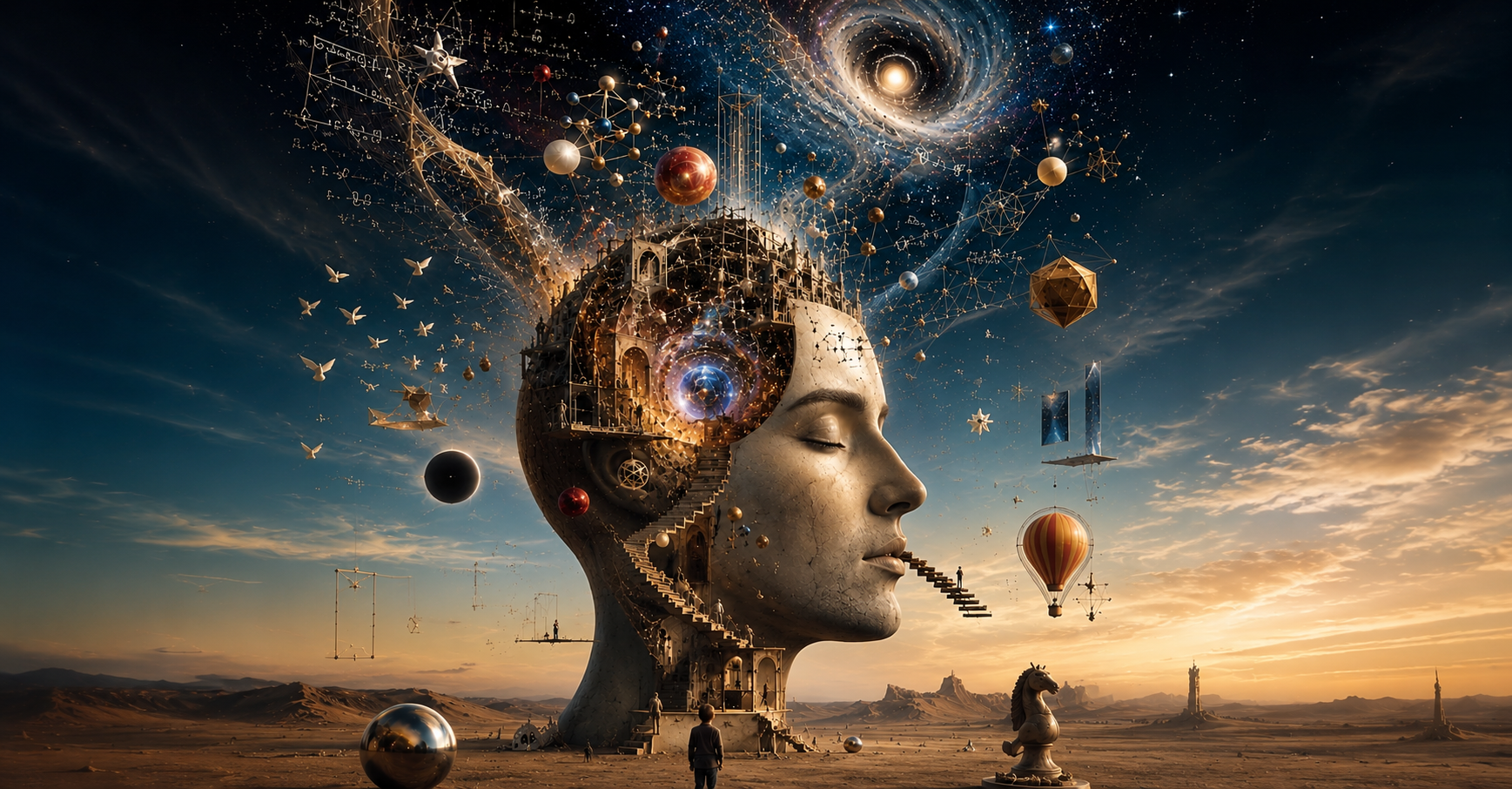
The Internal Made Visible: How Artificial Intelligence Is Unlocking the Minds of Autistic People
How AI is helping autistic and non-speaking individuals communicate, learn, and thrive by making internal thoughts visible and accessible.

The Internal Made Visible: How Artificial Intelligence Is Unlocking the Minds of Autistic People
By Melissa Barton June 2026
Jeremy is 31 years old and hasn't spoken a word in decades. Inside his mind, he's fluent thinking in complete sentences, forming opinions, experiencing the full spectrum of human emotion. The gap between his inner life and his ability to communicate it was one of the cruelest silences modern medicine has failed to bridge.
Then he tried an augmented reality headset. Within minutes, using a keyboard embedded in the device, he was typing words. After a 10-minute training procedure, he could construct sentences at a pace that felt, for the first time in his adult life, genuinely his own. He looked at the virtual keyboard and at the words appearing on the screen and he understood that whatever prison his brain had been building around his voice could have bars that opened.
Jeremy's breakthrough is part of a larger reckoning happening across neurodiversity. Artificial intelligence isn't just assisting autistic people it's translating the gap between how they think and how the world has demanded they communicate. And in doing so, it's raising a harder question: How many autistic minds have we been missing this entire time?
The Infrastructure of Expression
The story of AI and autism isn't primarily about cure. It's about infrastructure the tools that transform what autistic people have always been able to think into what the world can finally perceive.
An estimated 25 percent of children with autism are minimally or non-speaking. For decades, they were often treated as intellectually disabled by default. Speech-generating devices existed, but they required laborious manual selection from pre-loaded vocabulary trees a 30-minute process to build a simple conversation. The assumption was that their silence meant limited thought. It rarely meant anything of the sort.
In 2024, a team from Boston Children's Hospital launched QuickPic AAC, the first app to combine AI with augmentative and alternative communication. Instead of manually assembling vocabulary, the system generates relevant topic displays instantaneously. A photograph of a park appears, and the app auto-populates language for trees, children, sky, play everything the user might want to say about what they're seeing. The reduction in friction was transformative. What took 30 minutes now took seconds.
But communication about external reality is only part of the landscape. Autistic people have reported, across decades of research, that they experience visual thinking at a depth neurotypical researchers had difficulty fully grasping. Many autistic minds work in detailed pictures, spatial relationships, pattern visual metaphors that are difficult to translate into linear speech.
Until now, most autistic people lacked tools to externalize what was happening internally. A thought that existed as a complex, vivid, detailed image had to be compressed into words a fundamentally lossy translation. AI image generation platforms like DALL-E and Midjourney have begun to function as a different kind of communication tool: not for describing the external world, but for rendering the internal one.
What's in Your Head Can Now Become Real
The autistic experience of visual thinking is not metaphorical. Researchers have documented that autistic individuals use visual mental imagery more frequently than the general population not as a learning tool, but as the primary architecture of thought itself. For many, the world registers as a series of images, spatial systems, patterns, and textures before it registers as language.
For autistic children and adults, generative AI represents an accessibility tool that prior generations never had. An autistic artist can now describe, in text, the visual system they've been holding in their mind and watch it materialize in seconds. A non-speaking child can show their family, through generated images, what they've been thinking about.
In 2024, Alibaba launched an AI tool that has been used by over 50,000 families to create picture books for autistic children. Parents describe a child's interests or sensory preferences, and the system generates visual stories books tailored to that child's mind. One mother reported that her non-speaking autistic daughter, shown these AI-generated images, made sustained eye contact for the first time in months. The image was her language.
But there are complications. Research into text-to-image models has revealed that when prompted to create images of autistic people, these systems often default to harmful stereotypes: isolated individuals, engaged with objects rather than people, displaying exaggerated emotional expressions. The systems are learning from data created by a society that has misunderstood autism for centuries. The tools that could liberate autistic expression are also replicating autistic misrepresentation.
This contradiction tools built on flawed premises, yet still profoundly useful runs through every application of AI in autism care.
The Personalization Problem
Autistic children don't learn uniformly. The diversity within autism spectrum disorder is so profound that treating it as a single category has always been a kind of useful fiction. One child might hyperfocus on patterns and mathematics while struggling with social transitions. Another might have sophisticated language abilities but severe sensory processing challenges. A third might be nonspeaking and use visual-spatial thinking almost exclusively.
Traditional education often doesn't accommodate this variability. Autistic students are frequently placed in standardized curricula designed for neurotypical learning profiles, then labeled as struggling.
AI-driven personalized learning platforms like DreamBox and Smart Sparrow analyze how individual students respond to material, then adapt lessons in real time. The systems don't follow a predetermined curriculum; they follow the student. Research has demonstrated significant improvements in attention and retention when autistic students use these platforms, compared to traditional instruction.
The therapeutic side of AI integration is equally promising. Social skills, often a difficult area for autistic children, are being supported through AI tutors. A 2024 study showed that transformer-based models could deliver personalized social skills training to 30 autistic children over eight weeks, resulting in a 23.4 percent increase in social cue recognition and a 15.7 percent reduction in response latency. The system didn't teach autistic children to be neurotypical; it taught them to recognize patterns in neurotypical behavior that had previously seemed arbitrary.
But here emerges the same problem, repeating itself: these tools work. The question is who has access to them.
The Speed of Diagnosis
Autism diagnosis in children remains a bottleneck in many healthcare systems. Comprehensive evaluations can take months. Some children don't receive formal diagnosis until elementary school by which time intervention windows for certain developmental areas have narrowed.
AI-assisted screening is beginning to compress this timeline. Machine learning systems have been trained on thousands of diagnostic evaluations, and they can now identify behavioral patterns associated with autism at a level of accuracy that rivals human specialists. One screening system achieved a 97.95 percent accuracy rate in identifying autism in young children.
Early identification matters profoundly. Research is unambiguous: early intervention improves outcomes across cognitive, social, and adaptive domains. A child identified at age two versus age five has access to years of supportive learning and development. AI doesn't diagnose autism only clinicians can do that but it can flag risk factors and fast-track families to human evaluation.
Yet the infrastructure to act on these early warnings remains fragmented. A positive AI screening in a rural clinic might lead nowhere if no specialists practice within two hours. The technology is ahead of the system.
The Workplace Friction
The employment rate for autistic adults hovers between 35 and 50 percent far lower than rates for most disability categories. The barriers are often not cognitive but sensory and social: noise, unpredictable transitions, unstructured social interactions, unwritten workplace norms.
Research on autistic employees' accommodation preferences reveals what matters most: noise-canceling headphones, remote work options, electronic communication (rather than face-to-face meetings), flexible scheduling. Paradoxically, these are often the easiest accommodations to provide they cost less than specialized equipment or structural changes.
AI is beginning to fill specific gaps. Communication tools like the Autistic Translator (recently covered by the Washington Post) help non-autistic colleagues understand what autistic coworkers mean when literal language leads to misunderstanding. It's a small tool for a large problem, but it addresses one of the core barriers: the constant need to decode, re-explain, and translate across neurotypes.
Emerging platforms like Ariel use AI to help organize workflows and manage the cognitive load of workplace task management. These are not transformative tools; they are friction-reduction tools. But friction is often what keeps autistic people from thriving in environments where their actual work performance is strong.
Where Access Fails
None of this technology is cheap. Comprehensive AI-driven interventions require infrastructure, training, and integration that many healthcare systems particularly those serving low-income communities cannot afford. Implementation costs can be prohibitive, especially in countries with limited healthcare resources.
Researchers have sounded alarms about this disparity. AI tools designed in wealthy nations, trained on data from wealthy populations, deployed to wealthy healthcare systems they may deepen the existing gap between who gets diagnosed, who gets supported, and who remains invisible.
There is also the question of what gets built. AI tools in autism tend to focus on reducing behaviors that make neurotypical people uncomfortable stimming, atypical movement, social withdrawal. They are less focused on amplifying autistic strengths, building autistic community, or enabling autistic people to thrive in autistic ways. The technology reflects who built it.
Perhaps most concerning: many of these tools are designed around deficit-based frameworks. They aim to reduce the appearance of autism or train autistic people to behave more neurotypically. They don't ask what autism might look like if supported on its own terms, rather than in constant comparison to neurotypicality.
The Next Decade
AI will not cure autism. Autism is not a disease; it is a way of being. The emerging consensus in autistic self-advocacy is clear on this point: what is needed is not elimination but accommodation, not reduction of autistic traits but support for autistic people to exist and thrive in the world as it is and could be.
What AI can do and increasingly is doing is remove barriers. It can translate internal experience into external expression. It can personalize learning to the way an individual brain works rather than forcing that brain to conform to standardized curricula. It can reduce the sensory and cognitive friction of daily life. It can give voice to people who have been silent not because they had nothing to say, but because no tool existed to let them say it.
The critical question for the next decade is whether these tools will be designed with autistic people, rather than for them. It matters who is in the room when decisions are made about what constitutes improvement, what counts as progress, what autism "should" look like when supported by technology.
Jeremy, the 31-year-old man with the AR headset, was not made less autistic by accessing a tool that let him communicate. He was made more present. His thoughts, which had always existed, became knowable. His mind, which had always been active, became visible.
That is not a cure. It is an infrastructure. And for autistic people everywhere, it is everything.
Letter from the Editor
My own son, Alex, is now 25. He was voted out of kindergarten removed by school leadership without meaningful explanation, without accommodation consideration, without any real attempt to understand what was happening. If these tools had existed then, if the infrastructure to support his mind had been available, his entire trajectory might have been different. This piece isn't academic for me. It's personal.
- Melissa Barton
Sources
The Transmitter New Technology Gives Voice to Nonverbal People With Autism
Psychology Today Autism App Targets the "Holy Grail" of Communication
IEEE Spectrum The Quest to Ensure Nonspeaking Autistic People Are Heard
The Washington Post These Autistic People Struggled to Make Sense of Others. Then They Found AI
Frontiers in Psychiatry Implementation of Generative AI for the Assessment and Treatment of Autism Spectrum Disorders: A Scoping Review
Frontiers in Psychiatry Exploring the Application of AI in the Education of Children with Autism: A Public Health Perspective
Medium Beyond "Severe Autism": Why 2025 AAC Tech Changes Everything
NCBI AI-Assisted Early Screening, Diagnosis, and Intervention for Autism in Young Children
MDPI / International Journal of Environmental Research and Public Health Autistic Employees' Technology-Based Workplace Accommodation Preferences Survey Preliminary Findings
About the Author
Melissa Barton is the Founder of PalmBeachCounty.ai, an AI strategist, consultant, and marketing operations executive focused on emerging technologies, business transformation, and the real-world impact of artificial intelligence across healthcare, education, accessibility, and society.
Learn more about Melissa Barton and her work in artificial intelligence, business strategy, and emerging technologies: https://palmbeachcounty.ai/about
Related Articles
- Artificial Intelligence and Autism: Opportunity, Independence, and the Future of Neurodiversity A comprehensive look at AI tools, employment, and ethical considerations for autistic individuals.
- AI Governance Framework for Business How organizations build responsible, accountable AI policies.
- AI for Nonprofits and Fundraising Practical AI adoption strategies for mission-driven organizations.
- AI Grant Writing for Nonprofits Using AI across the full grant development lifecycle.
- AI Adoption Roadmap for Organizations A structured framework for workforce readiness and AI integration.
Explore Topics
Written by
Melissa Barton
Founder of PalmBeachCounty.ai · AI Consultant · Marketing Strategist
Melissa Barton is a Florida AI consultant and marketing strategist with more than 25 years of experience. She holds a Google AI Professional Certificate and seven Anthropic Academy certifications. She works with businesses, nonprofits, and government agencies across South Florida on AI strategy, marketing operations, and organizational transformation.